
Teeth whitening is one of the most sought-after aesthetic treatments in dental clinics in Portugal. The promise of a brighter, lighter smile is appealing — but there is a lot of misinformation about how it works, what can be achieved and what the real risks are. In this article we explain everything with clinical rigour: from European regulations to the most common myths, covering the available methods and the after-care following treatment.
How Does Teeth Whitening Work?
The active ingredient in whitening gels is hydrogen peroxide (H₂O₂) or its precursor, carbamide peroxide. As they penetrate the enamel and dentine, these molecules release active oxygen that breaks the bonds of the pigment molecules accumulated in the tooth structure, making them colourless.
The process does not remove tooth structure — it acts chemically on the chromogens (the substances that give colour). That is why whitening does not work on crowns, veneers, implants or composite restorations: it only lightens natural tooth structure.
What the Law Says in Portugal and Europe
Many patients are unaware that teeth whitening has been regulated by European legislation since 2011. Directive 2011/84/EU — transposed into Portuguese law by Decree-Law No. 113/2012 of 26 May — sets strict limits on the concentration of hydrogen peroxide in whitening products:
- Over-the-counter products (pharmacy, supermarket) — a maximum of 0.1% H₂O₂. At this concentration, the whitening effect is minimal to non-existent. That is why the “whitening strips” or “whitening pastes” sold without prescription produce very limited results.
- Professional in-clinic use — up to 6% H₂O₂ (or the equivalent in carbamide peroxide). These may only be used by dentists or under direct supervision, following a clinical assessment.
- Supervised home use — the dentist may supply gels of up to 6% concentration for use in custom trays at home, provided it is prescribed and clinically monitored.
In practice, this means that effective whitening is only possible with professional supervision. Products with concentrations above 6% are banned in the European Union for dental use — unlike in other countries (USA, Brazil), where concentrations of up to 35–38% were historically common in the clinic.
In-Clinic vs. At-Home Whitening: What’s the Difference?
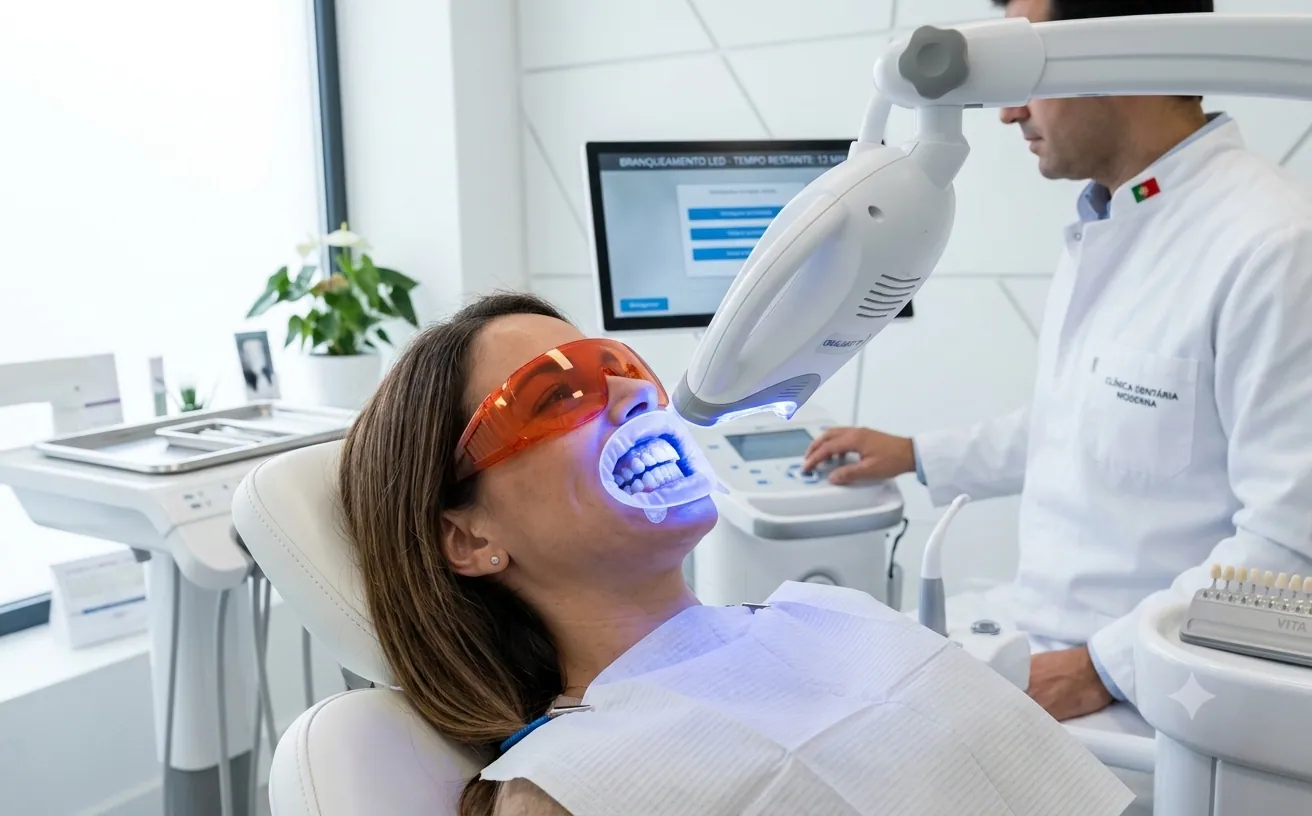
There are two main methods of professional whitening, each with advantages and limitations. At Porto Smile, the most effective approach combines the two:
| Criterion | In-clinic | At-home |
|---|---|---|
| Gel concentration | Up to 6% H₂O₂ | Up to 6% H₂O₂ (tray) |
| Activation | LED light (speeds up the reaction) | No activation |
| Time per session | 60–90 minutes | 2–4 hours/day, 10–14 days |
| Speed of results | Immediate (1 session) | Gradual (1–2 weeks) |
| Tooth sensitivity | Higher (more concentrated gel) | Lower (more gradual) |
| Professional control | Full (dentist present) | Partial (custom tray) |
| How long results last | 1–2 years | 1–3 years |
| Cost | Higher | More affordable |
Combined protocol (recommended): one in-clinic session for an immediate initial result, followed by at-home treatment to consolidate and prolong the results. It is the method with the most robust evidence of effectiveness and durability.
What Shade Can Be Achieved?
This is one of the most important expectations to manage before treatment. The final shade depends on several factors: the base colour of the teeth, the thickness of the enamel, the origin of the staining (intrinsic or extrinsic) and the individual response to the gel.
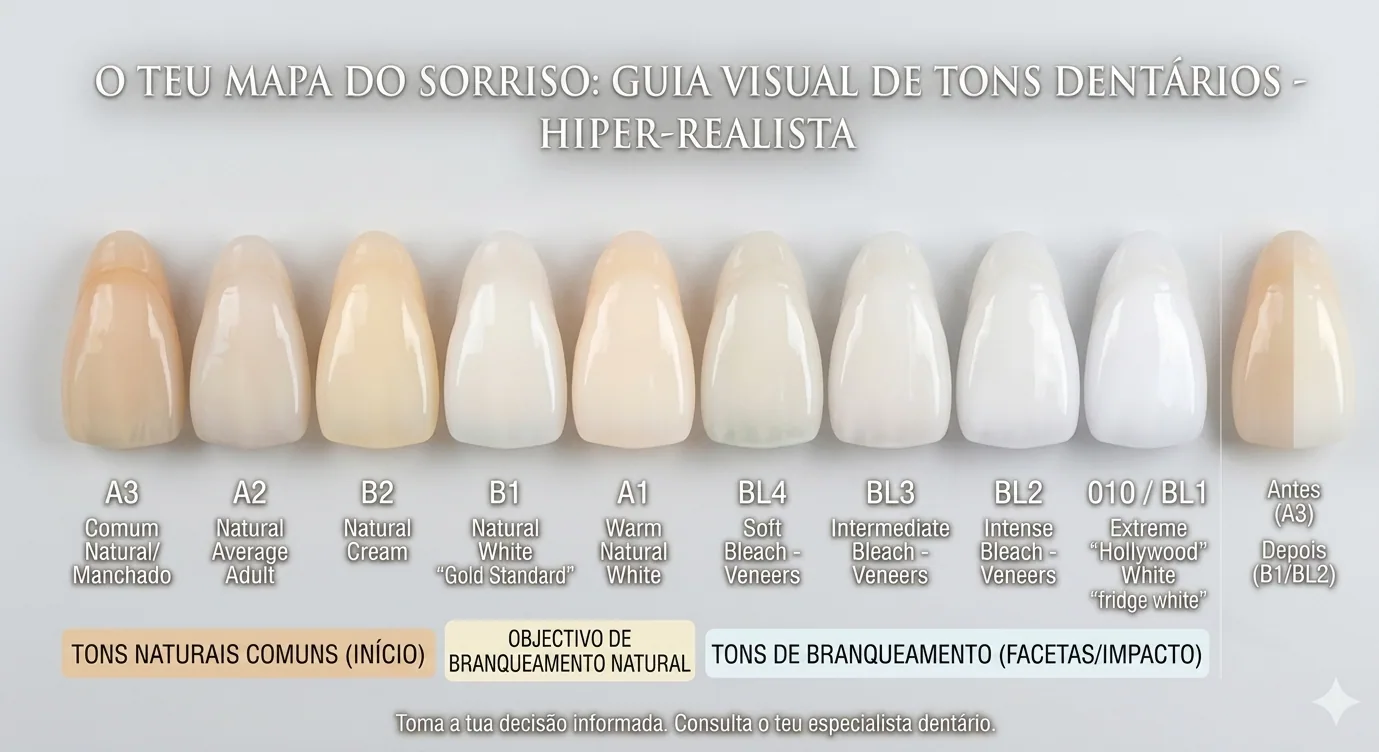
Professionals use the VITA shade guide to classify tooth colours. Most people with natural teeth can achieve an improvement of 4 to 8 shades on the VITA guide with professional whitening. The lightest shades on the guide (B1, A1) are achievable for most people. The “Hollywood white” — shades almost as white as paper — is rarely possible with whitening alone and may require porcelain or composite veneers.
Stains of intrinsic origin (fluorosis, tetracyclines, dental trauma) respond more poorly to whitening and may require complementary approaches such as microabrasion or coverage with veneers.
Myths and Facts about Teeth Whitening
❌ “Whitening destroys the tooth pulp”
MYTH. When carried out with the concentrations permitted by law (≤6% H₂O₂) and with a correct clinical protocol, whitening does not damage the pulp. Histological studies show that pulp changes are transient and reversible. The risk exists with very high concentrations (>30%) — which are banned in the EU precisely for this reason.
❌ “Whitening weakens the teeth permanently”
MYTH (with nuance). The whitening gel causes a temporary demineralisation of the enamel during treatment — which is why sensitivity can appear. However, remineralisation is complete within 24–48 hours after each session, especially with the use of fluoride toothpaste. Excessively frequent treatments, or those with concentrations above the permitted limit, can cause cumulative damage — which is why professional supervision is essential.
❌ “Whitening works on crowns and implants”
MYTH. Hydrogen peroxide acts only on organic tooth structure. Porcelain crowns, veneers, composites and implants do not whiten. If you have visible restorations on the front teeth, whitening can create an unwanted colour difference — something the dentist should assess before starting treatment.
✅ “Tooth sensitivity during whitening is normal”
FACT. Most patients feel some degree of sensitivity during or after the sessions. This sensitivity is temporary and usually stops within 24–48 hours. Using desensitising gels with potassium nitrate or fluoride, before and after the sessions, significantly reduces this discomfort.
❌ “Whitening results are permanent”
MYTH. The results last between 1 and 3 years, depending on dietary and oral hygiene habits. Coffee, tea, red wine, red berries and tobacco are the main factors in relapse. Periodic maintenance sessions (usually once a year) prolong the results.
✅ “A prior clinical assessment is required”
FACT — and required by law. Directive 2011/84/EU requires that any use of products with >0.1% H₂O₂ be preceded by an assessment by a dentist. This assessment includes analysing the state of the enamel, the presence of cavities or restorations, and a history of sensitivity — factors that determine the most suitable protocol.
What Not to Do After Whitening
In the first 48 hours after each session — the period when the pores of the enamel are most open — you should avoid:
- Coffee and tea — highly staining
- Red wine and dark fruit juices
- Tomato sauce, beetroot, curry and other coloured condiments
- Red berries (blueberries, raspberries, blackberries)
- Tobacco — tar stains the enamel quickly after whitening
- Acidic soft drinks — they increase sensitivity and transient demineralisation
The practical rule is simple: if a food stains a white cloth, avoid it in the first 48 hours. Choose light-coloured foods — chicken, fish, rice, banana, plain yoghurt, fresh cheese.
How Often Can You Whiten Your Teeth?
The general clinical recommendation is not to carry out a full whitening treatment more than once a year. Shorter maintenance sessions (a touch-up with an at-home tray for 2–3 days) can be done every 6–12 months to prolong the results without overloading the enamel.
Excessively frequent whitening, even within the legal concentrations, can accumulate enamel damage over the long term. The dentist sets the appropriate frequency based on the condition of the enamel and the response to previous treatment.
Who Should Not Have Teeth Whitening
- Pregnant and breastfeeding women — as a precaution, in the absence of conclusive studies on foetal safety
- Under-18s — the enamel is still maturing and the pulp is larger and more sensitive
- Teeth with heavily worn enamel or compromised by erosion/bruxism
- Active cavities or periodontal disease — these must be treated first
- Severe tooth hypersensitivity — it can be made worse; it requires a prior approach
- Extensive restorations on the front teeth — risk of a visible colour difference
At Porto Smile, the prior assessment appointment for whitening is included in the protocol — it is the only way to ensure that the treatment is safe, suitable and that the results match the patient’s expectations. Book your assessment and discover the smile you can achieve.
Want to know whether whitening is right for you?
At Porto Smile we carry out a prior assessment to ensure that whitening is safe and effective for your teeth. Discover our professional whitening service.
Have questions about this topic? Our team is here to help.
Book a Consultation