
“If I were fine, I wouldn’t be here.” It is an answer that doctors hear often — and dentists are no exception. This phrase sums up one of the biggest misconceptions about oral health: the idea that you only go to the dentist when something goes wrong, when the pain is already unbearable or when the tooth is already visibly compromised. The reality of modern medicine — and of dentistry in particular — is completely different.
The Dentist Is Not Just for Emergencies
Think about other medical specialties. A man who goes to the urologist to have his prostate checked does not need to have symptoms — he goes because prevention makes it possible to detect early changes when treatment is simpler, less invasive and has a better prognosis. A woman who goes to the gynaecologist for a smear test and breast ultrasound does not wait to feel a lump — she goes because screening saves lives.
Dentistry works in exactly the same way. A cavity detected at an early stage is treated with a small filling in a single appointment. The same cavity ignored for months can reach the pulp, require a root canal treatment and eventually compromise the tooth irreversibly. The difference between these two scenarios is called prevention — and it is the main service a dental clinic can provide to its patient.
The Four Levels of Care in Dentistry
As in general medicine, dentistry is organised into levels of intervention that reflect how early and how complex the required treatment is:
Primary Care — Prevention and Guidance
This is the least invasive and most effective level. It includes six-monthly routine appointments, scaling (removal of tartar), fissure sealants, topical fluoride application and — fundamentally — educating the patient about correct oral hygiene. There are no painful procedures, no drills, no downtime. The aim is that the patient never needs the following levels.
Secondary Care — Restoration and Active Treatment
When prevention has failed or been neglected, the secondary level comes into play: composite fillings, orthodontic treatments to correct the bite, periodontal therapy to treat gum disease, crowns to protect weakened teeth. These are more complex treatments, with more sessions and a higher cost — but they still make it possible to preserve the tooth.
Tertiary Care — Rescue Treatments
When the situation has advanced significantly, rescue treatments are needed: root canal treatments, extractions due to severe decay or fracture, periodontal surgery to treat advanced gum disease. The aim is no longer just to treat — it is to try to save what can be saved or to eliminate sources of infection.
Late Care — Rehabilitation
When the tooth can no longer be saved or has already been lost, rehabilitation involves dental implants, fixed bridges or removable dentures. These are the most costly, most time-consuming solutions, with the greatest impact on the patient’s quality of life — and which in most cases could have been avoided with consistent primary care.
The conclusion is simple: the earlier you act, the less invasive the treatment, the lower the cost and the better the result. Prevention is not a luxury — it is the smartest and most economical option in the long term.
A Guide to Oral Hygiene at Home
The foundation of prevention begins at home, with correct daily habits. Most people brush their teeth — but not always in the most effective way.
The Ideal Toothbrush
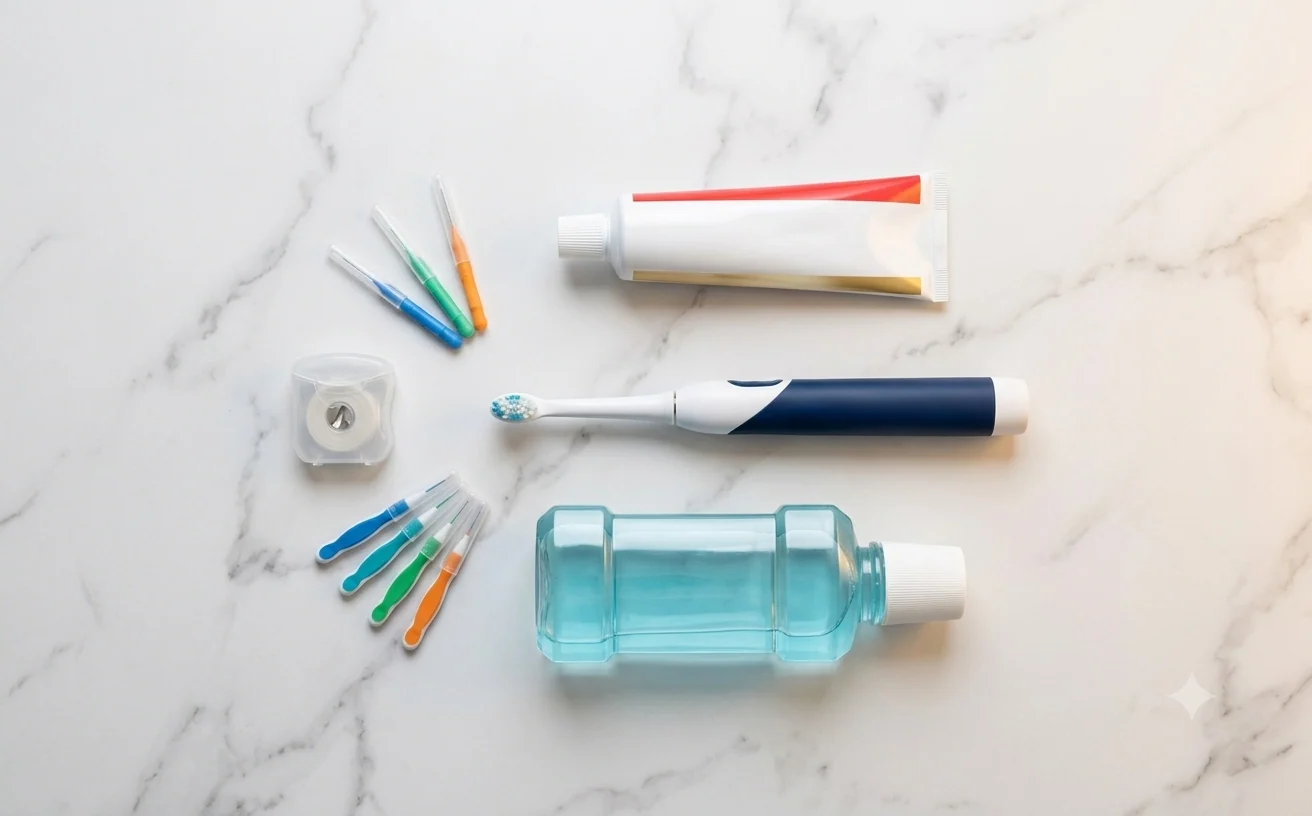
A toothbrush should have a small head (to reach the back teeth), soft or extra-soft bristles (hard bristles damage the enamel and the gums) and an ergonomic handle. Electric toothbrushes with an oscillating head have scientific evidence of greater effectiveness at removing plaque compared with manual brushes — especially in patients with difficulty in motor coordination or with braces. Change the brush (or the head of the electric brush) every 3 months or when the bristles are deformed.
The Ideal Toothpaste
The most important ingredient in a toothpaste is fluoride. For adults, the recommended concentration is 1,000 to 1,500 ppm (parts per million) of fluoride — present in most everyday toothpastes. “Natural” fluoride-free toothpastes have no proven effectiveness in preventing cavities. Toothpastes for sensitive teeth contain potassium nitrate or arginine, which block the dentinal tubules. Whitening toothpastes contain abrasive particles — use them in moderation so as not to wear down the enamel.
Brushing Technique and Frequency
Brush your teeth at least twice a day — and always before bed, when saliva production decreases and bacteria become more active. Brushing should last a full two minutes (most people brush for 45 seconds). The recommended technique is the modified Bass technique: position the brush at 45° to the gum and make gentle circular movements, starting with the outer surface of the upper teeth, then the inner surfaces, then the lower teeth. Don’t forget the tongue — it is a reservoir of the bacteria responsible for bad breath.
Dental Floss and Tape
The brush only cleans 60% of the tooth surfaces. The remaining 40% — the spaces between the teeth — can only be reached with dental floss or tape (or interdental brushes, recommended when the gaps are larger). Daily flossing is essential and has no substitute. The correct technique: use about 40 cm of floss, wind most of it around your middle fingers and slide it gently between each pair of teeth, forming a “C” around each tooth and going slightly under the gum. If the gums bleed at first, that is no reason to stop — it is a sign that you need to do it more regularly.
Bleeding Gums — Should You Worry?
Yes. Bleeding gums when brushing or flossing is the earliest sign of gingivitis — inflammation of the gums caused by the build-up of plaque. Many people ignore this sign or stop flossing so as “not to hurt themselves” — which makes the problem worse.
Gingivitis is fully reversible with a professional scaling and improved oral hygiene at home. Left untreated, it can progress to periodontitis — a disease that destroys the bone and the supporting tissues of the teeth, and can lead to their loss. Periodontitis is silent in its early stages: it does not hurt, but it advances. By the time the patient feels the teeth moving, bone loss may already be significant.
Bad Breath and Bad Taste — What Do They Mean?
In the vast majority of cases, chronic bad breath (halitosis) has an oral origin: a build-up of bacteria on the tongue, periodontal disease, untreated cavities or ill-fitting dentures. Only a small percentage has a systemic origin (gastrointestinal diseases, diabetes, kidney failure). Bad breath that persists after careful brushing and flossing deserves a clinical assessment.
A persistent bad taste — especially metallic or bitter — can indicate an active infection, periodontal disease or deep decay involving the pulp. In any case, it is a warning sign that should not be ignored.
Myths and Facts about Oral Health
❌ “I only need to go to the dentist when something hurts”
MYTH. Decay, periodontal disease and oral tumours are often symptom-free in the early stages. By the time symptoms appear, the treatment required is generally more complex. A six-monthly appointment makes it possible to detect and treat before it hurts.
❌ “Brushing harder cleans better”
MYTH. Excessive pressure wears down the enamel and causes the gums to recede — an irreversible process. The effectiveness of brushing depends on technique and time, not on force.
✅ “Tartar cannot be removed with a toothbrush”
FACT. Plaque (soft) is removed with a brush. Tartar is mineralised plaque — it can only be removed with professional instruments during a scaling. That is why even those who brush correctly need regular scaling.
❌ “Mouthwash replaces brushing”
MYTH. Mouthwash is a complement, never a substitute. It does not remove plaque mechanically — it only temporarily reduces the bacterial load and freshens the breath.
❌ “Baby teeth don’t need care — they’ll fall out anyway”
MYTH. Cavities in baby teeth cause pain, infections and can affect the development of the permanent teeth. Oral hygiene habits are formed in childhood — and last a lifetime.
✅ “Pregnancy affects oral health”
FACT. The hormonal changes of pregnancy increase susceptibility to gingivitis. Untreated periodontal disease is associated with premature birth and low birth weight. A dental appointment during pregnancy is safe and recommended.
How Often Should You Go to the Dentist?
The general recommendation is a routine appointment every 6 months. Patients with a history of periodontal disease, frequent cavities, diabetes or braces may benefit from more frequent appointments — the dentist sets the appropriate interval for each case.
At Porto Smile, the routine appointment includes a complete clinical assessment, screening X-rays when indicated, scaling and personalised oral hygiene guidance. Because the best treatment is the one that never needs to happen.
Book your prevention appointment — and look after your smile before it needs treating.
Porto Smile · Specialty
Your periodontology specialist is here
Dr Elton Dias is a periodontology specialist — not a general practitioner treating gums. Scaling, periodontitis, bone regeneration, aesthetic gum surgery and much more.
Bleeding gums? A loose tooth? Sensitivity? Don’t wait.
Have questions about this topic? Our team is here to help.
Book a Consultation